Physics is entering an era where discovery is no longer driven solely by equations on a chalkboard or experiments in isolated laboratories. Instead, a new partnership is taking shape between human insight and artificial intelligence, reshaping how scientists explore the laws of nature. From parsing colossal datasets to proposing theories, AI is rapidly becoming an indispensable collaborator in modern physics.
TLDR: Artificial intelligence is transforming physics by accelerating data analysis, enhancing simulations, and uncovering patterns hidden in complexity. Rather than replacing physicists, AI augments human creativity and intuition. This partnership is enabling breakthroughs across particle physics, cosmology, materials science, and beyond, making AI one of the most powerful tools physics has ever known.
For decades, physics advanced through a balance of theoretical modeling and experimental validation. As instruments improved, they produced ever larger volumes of data, pushing traditional analysis methods to their limits. Today, experiments at facilities like particle accelerators, space telescopes, and gravitational wave observatories generate petabytes of information. AI systems, particularly those based on machine learning, have proven uniquely suited to handle this scale and complexity.
At its core, AI excels at identifying patterns within vast, multidimensional datasets. In physics, such patterns often correspond to rare events, subtle correlations, or emergent behaviors that are difficult for humans to detect unaided. By training algorithms on simulated or experimental data, physicists can rapidly sift through noise and focus on signals that matter.
Particle physics offers a compelling example. Experiments at the Large Hadron Collider generate billions of particle collisions per second. Only a tiny fraction may contain evidence of new physics. Machine learning models now act as intelligent filters, distinguishing meaningful events from background clutter with remarkable efficiency. This approach has not only accelerated discoveries but also improved the precision of known measurements.
Beyond data analysis, AI is redefining how physicists build and test theories. Traditionally, simulations of complex systems—such as turbulent plasmas or many-body quantum systems—required enormous computational resources. AI-based surrogate models can approximate these simulations at a fraction of the cost, allowing researchers to explore broader parameter spaces. This has opened new doors in fields like astrophysics and climate physics, where understanding extreme and nonlinear systems is essential.
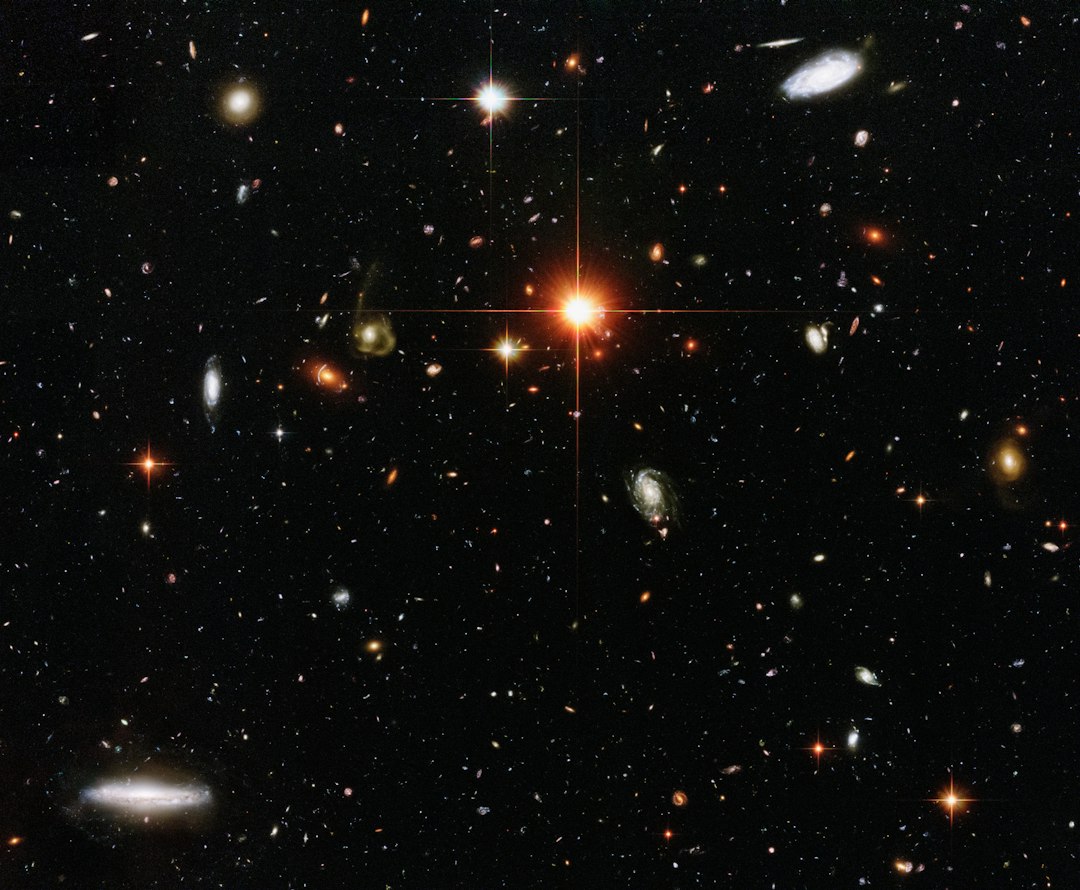
In cosmology, AI helps map the large-scale structure of the universe by connecting observations to theoretical models. Algorithms can infer the distribution of dark matter, classify galaxies, and even simulate cosmic evolution. These tasks push beyond what deterministic equations alone can accomplish, especially when uncertainty and incomplete data dominate.
Equally transformative is AI’s role in discovering new physical laws and materials. By analyzing experimental results and simulation outputs, machine learning systems can suggest hypotheses that humans might overlook. In materials science, AI accelerates the search for superconductors, batteries, and quantum materials by predicting properties before physical samples are created. Physicists then validate and refine these predictions, tightening the feedback loop between theory and experiment.
Crucially, this partnership does not diminish the importance of human physicists. Instead, it changes their role. Humans define the questions, interpret results, and ensure that models respect fundamental principles such as symmetry and conservation laws. AI provides speed, scalability, and a fresh perspective, often revealing relationships that challenge existing assumptions.
There is also a growing effort to make AI systems more transparent and physically informed. Rather than treating algorithms as black boxes, researchers embed known physical constraints directly into models. This approach, sometimes called physics-informed machine learning, ensures that predictions remain consistent with established laws while still benefiting from data-driven flexibility.
Despite its promise, the rise of AI in physics brings challenges. Overreliance on automated methods can obscure underlying mechanisms if results are accepted uncritically. Biases in training data can mislead conclusions, and opaque models may resist interpretation. Addressing these issues requires rigorous validation, interdisciplinary collaboration, and a commitment to scientific transparency.
Education is also evolving in response. Future physicists are increasingly trained in data science and machine learning alongside classical mechanics and electromagnetism. This hybrid skill set reflects the reality of modern research, where fluency in both physics and computation is essential. As a result, AI literacy is becoming as fundamental as calculus once was.
The broader impact of this partnership extends beyond academia. Technologies developed at the intersection of AI and physics influence industries ranging from energy and telecommunications to medicine and aerospace. Advances in imaging, optimization, and prediction often trace their origins back to fundamental physics research empowered by intelligent algorithms.
Looking ahead, the collaboration between AI and physics is poised to deepen. As algorithms become more adaptive and physical theories more data-driven, the boundary between computation and insight will continue to blur. Rather than replacing scientific creativity, AI amplifies it, allowing physicists to tackle questions once thought intractable.
In this emerging landscape, physics is no longer just a human endeavor guided by equations and experiments. It is a shared enterprise, where intelligent machines and human reasoning work together to uncover the structure of reality. This new scientific partnership may ultimately redefine how knowledge itself is discovered.
Frequently Asked Questions
- Does AI replace physicists?
No. AI augments human capabilities by handling large datasets and complex modeling, while physicists provide intuition, theory, and interpretation. - Which areas of physics benefit most from AI?
Fields with large or complex datasets, such as particle physics, cosmology, materials science, and plasma physics, see especially strong benefits. - What is physics-informed machine learning?
It is an approach where AI models are designed to respect known physical laws, improving reliability and interpretability. - Are there risks in using AI for physics research?
Yes. Potential risks include biased data, lack of transparency, and overreliance on automated results without physical understanding. - How is AI changing physics education?
Physics curricula increasingly include machine learning, data science, and computational methods to prepare students for modern research environments.